Western Worlds: a day at Yeats & the West

Yeats and the West logo

WESTERN WORLDS

a Yeats & the West day

Friday 27th November 2015

Hardiman Research Building, NUI Galway

Wall Vinyl 2

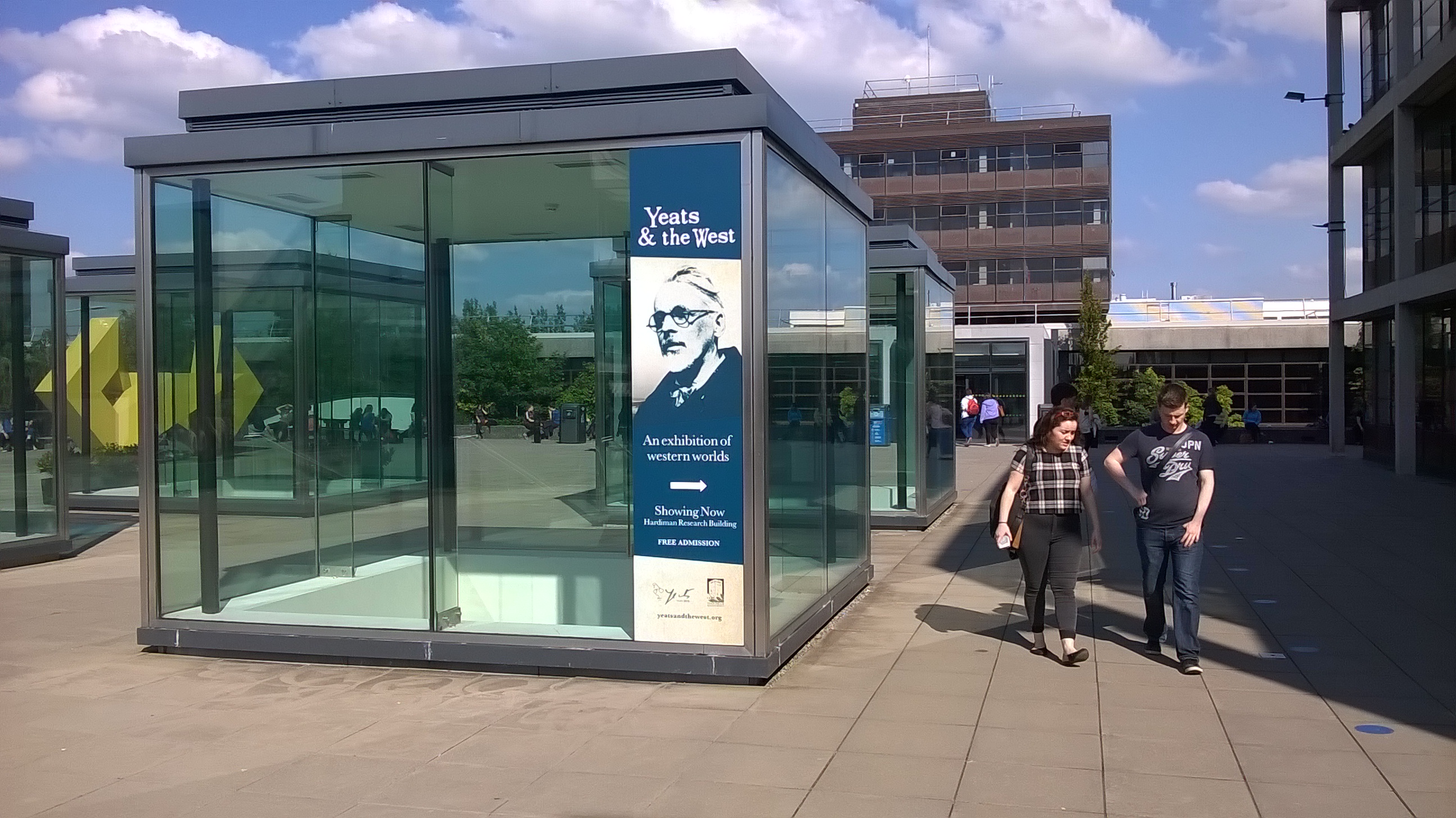
William Butler Yeats, poet, playwright, politician, and Nobel prize-winner for literature, always looked west. The Yeats & the West exhibition at NUI Galway, with rare books, art, music, drama, and film, discovers what the west meant to him, and what this means for us. As part of the Yeats & the West programme, the day-long symposium Western Worlds tells the story of the western cultural revolution that shaped modern Ireland. Featuring talks on W.B.Yeats’s poems, plays, artistic collaborations and love affairs, and featuring his co-conspirators Jack B. Yeats, J.M. Synge, Padraic Pearse and Eva Gore Booth, it includes poetry readings and an exclusive interview with the artist John Behan about current exhibitions of Yeatsian-themed sculptures and drawings. Western Worlds tells a story of going west to find those places, real and imaginative, that change our sense of where and who we are.

yeats promo 2

Yeats & West Western Worlds2

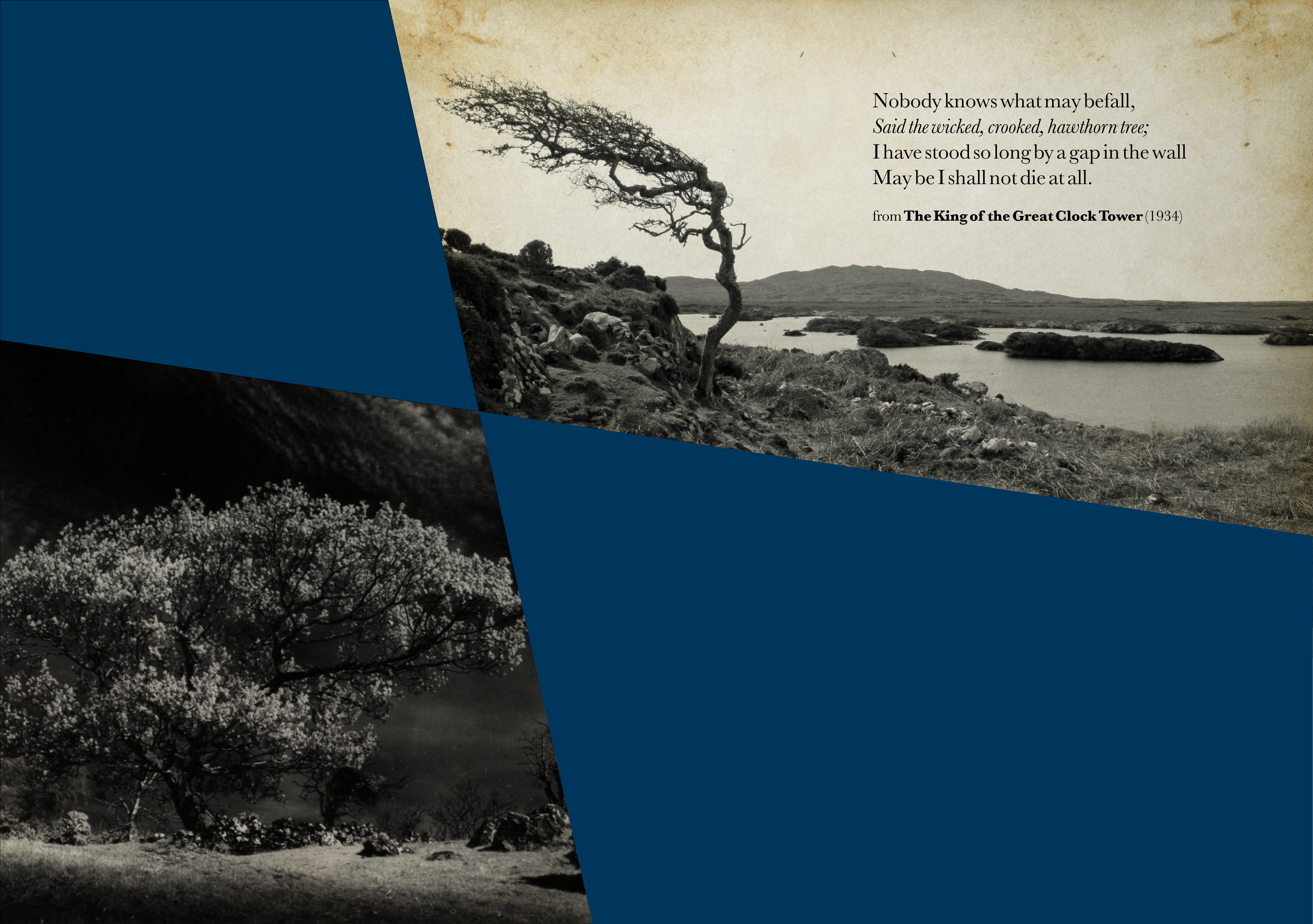
cropped-f-bourke-hawthorn-connemara.jpg


Western Worlds: A Day at Yeats & the West

Bridge Seminar Room, Hardiman Research Building, NUI Galway

Friday 27th November 2015

10.45am Welcome & Kisses

Adrian Frazier  Yeats & Maud Gonne: The Meaning of Their Kisses

12pm   Poems

Brian Arkins    W.B.Yeats & G.M. Hopkins

Deirdre Ní Chonghaile  ‘Listening to this rude and beautiful poetry’: J.M. Synge as song collector in the Aran Islands

1pm       Lunch

2pm       Plays                                                                      

Barry Houlihan ‘Suffering Spirits and Remorseful Dead’: Remembrance and Re-enactments in the plays of W.B. Yeats

Ian Walsh The Painted Play: Jack B. Yeats and the Postdramatic Theatre

3pm   Revivals

Mary Harris   Realism, Idealism and the Gaelic Revival

Maureen O’Connor   Some Vague Utopia: Eva Gore-Booth’s The Death of Fionavar (1916)

4pm   Coffee

4.30  Arts

Adrian Paterson with Barry Houlihan  (curators of Yeats & the West) Yeats among the Arts: exhibition highlights tour

from 5pm in Special Collections

5.30pm   Poems

David Clare & Deirdre Clare   dramatic readings

6.30pm  Reception

7pm   Bulls

John Behan  The Bull of Sheriff Street in conversation

cropped-f-bourke-hawthorn-connemara1.jpg

yeatsandthewest.org


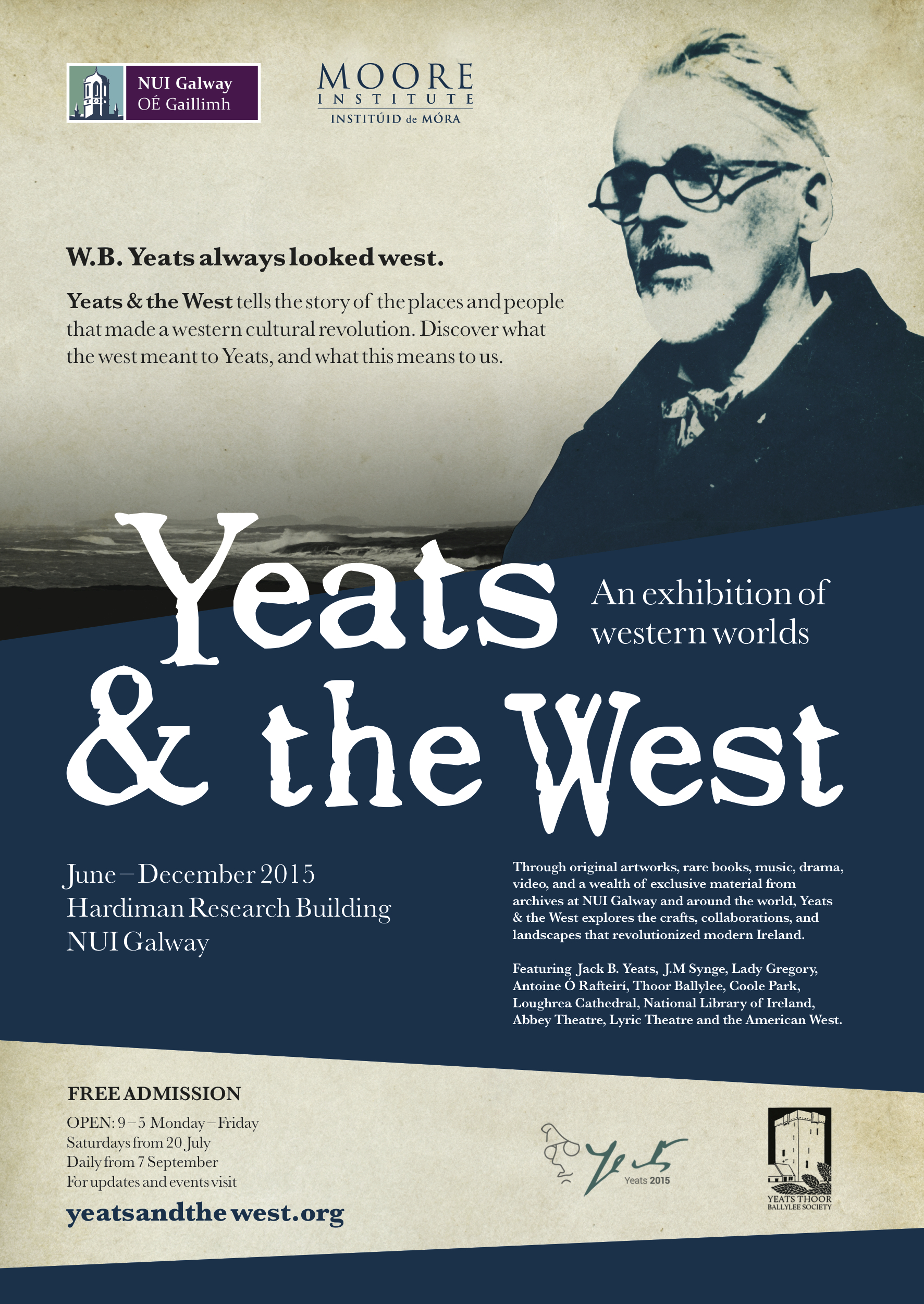
YeatsandtheWestA3Poster_ART2croppedJPEG


Western Worlds: a Yeats & the West symposium

WESTERN WORLDS

a Yeats & the West symposium

Friday 27th November 2015

Hardiman Research Building, NUI Galway

Wall Vinyl 2

William Butler Yeats, poet, playwright, politician, and Nobel prize-winner for literature, always looked west. The Yeats & the West exhibition at NUI Galway, with rare books, art, music, drama, and film, considers what the west meant to him, and what this means for us. As part of the Yeats & the West programme, the day-long symposium Western Worlds tells the story of the western cultural revolution that shaped modern Ireland. Featuring talks on W.B.Yeats’s poems, plays, artistic collaborations and love affairs, and featuring his co-conspirators Jack B. Yeats, J.M. Synge, Padraic Pearse and Eva Gore Booth, it includes poetry readings and an exclusive interview with the artist John Behan about current exhibitions of Yeatsian-themed sculptures and drawings. Western Worlds tells a story of going west to find those places, real and imaginative, that change our sense of where and who we are.

yeats promo 2

YeatsandtheWestA3Poster_ART2croppedJPEG


Culture Night at Yeats & the West

Culture Night at Yeats & the West

Culture Night

Friday 18th September 5-9pm

Tours, talks, & more!

Free admission

Yeats & the West tells the story of the places and the people that made a western cultural revolution. Discover what the west meant to Yeats, and what this means to us.

Culture Night at Yeats & the West features extended opening hours until 9pm, free admission, and exclusive tours every hour on the hour at 5pm, 6pm, 7pm, and 8pm, by exhibition curators Adrian Paterson and Barry Houlihan.

It also features a new arrangement and rotation of items on display, and unique and personal access to material in special collections. Among many new selections specially on view for this week are:

WP_20150910_023

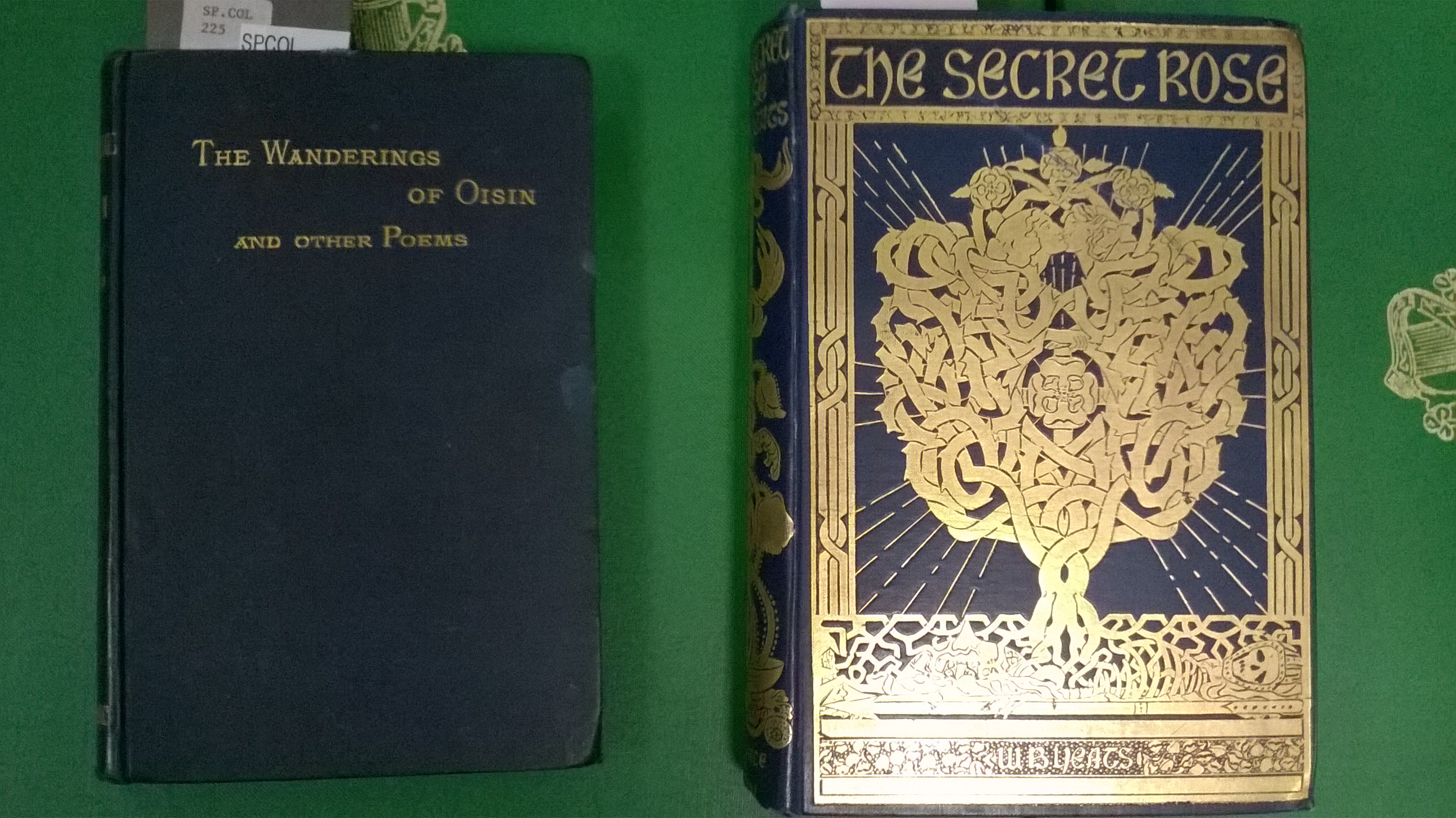
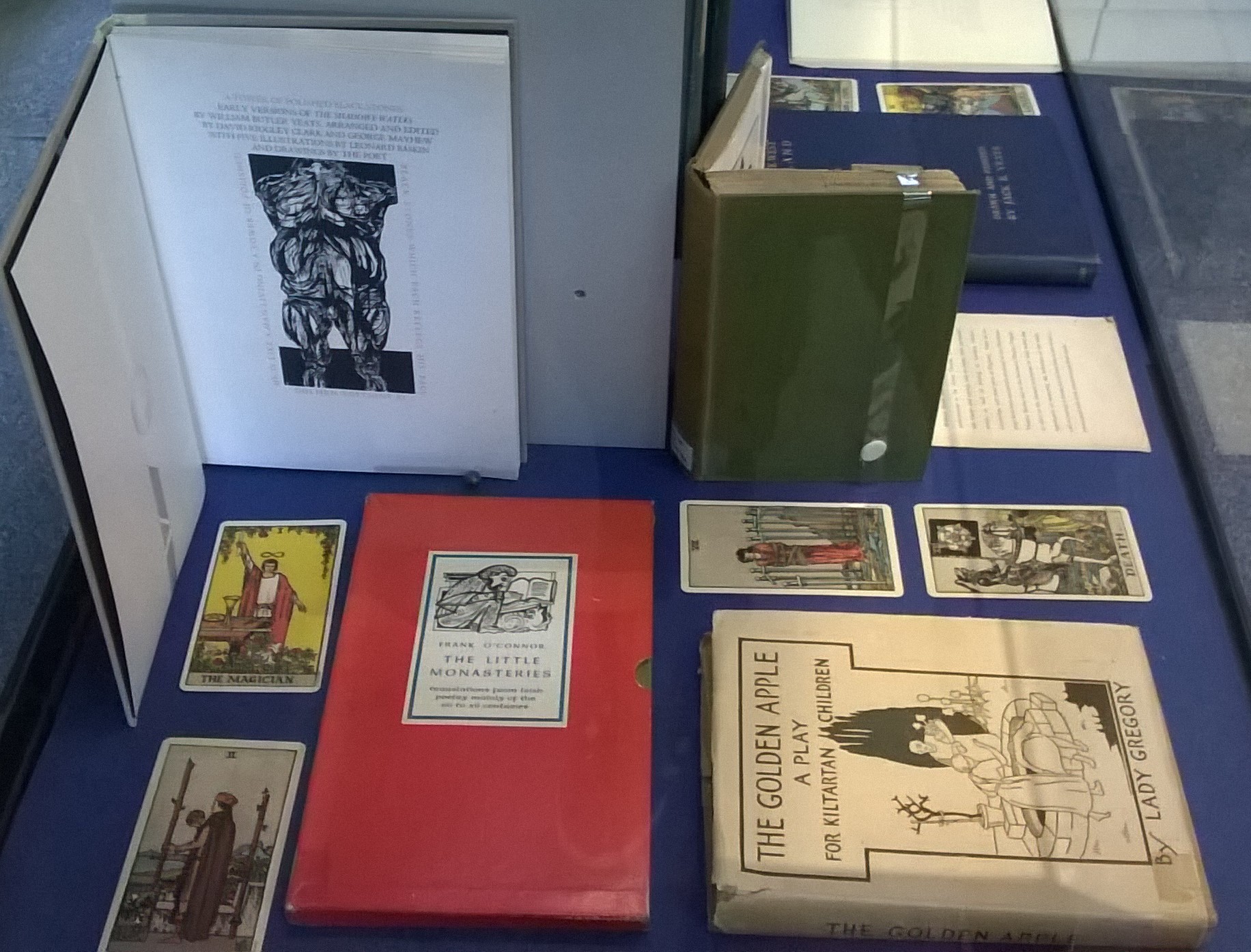
A new selection of first editions: Yeats’s first book, The Wanderings of Oisin and Other Poems (1889), so admired by William Morris, and his book of symbolist stories set in Irish landscapes The Secret Rose (1897), illustrated by a spectacular Rosicrucian tree design in gilt and leather binding by Althea Gyles.

WP_20150910_036

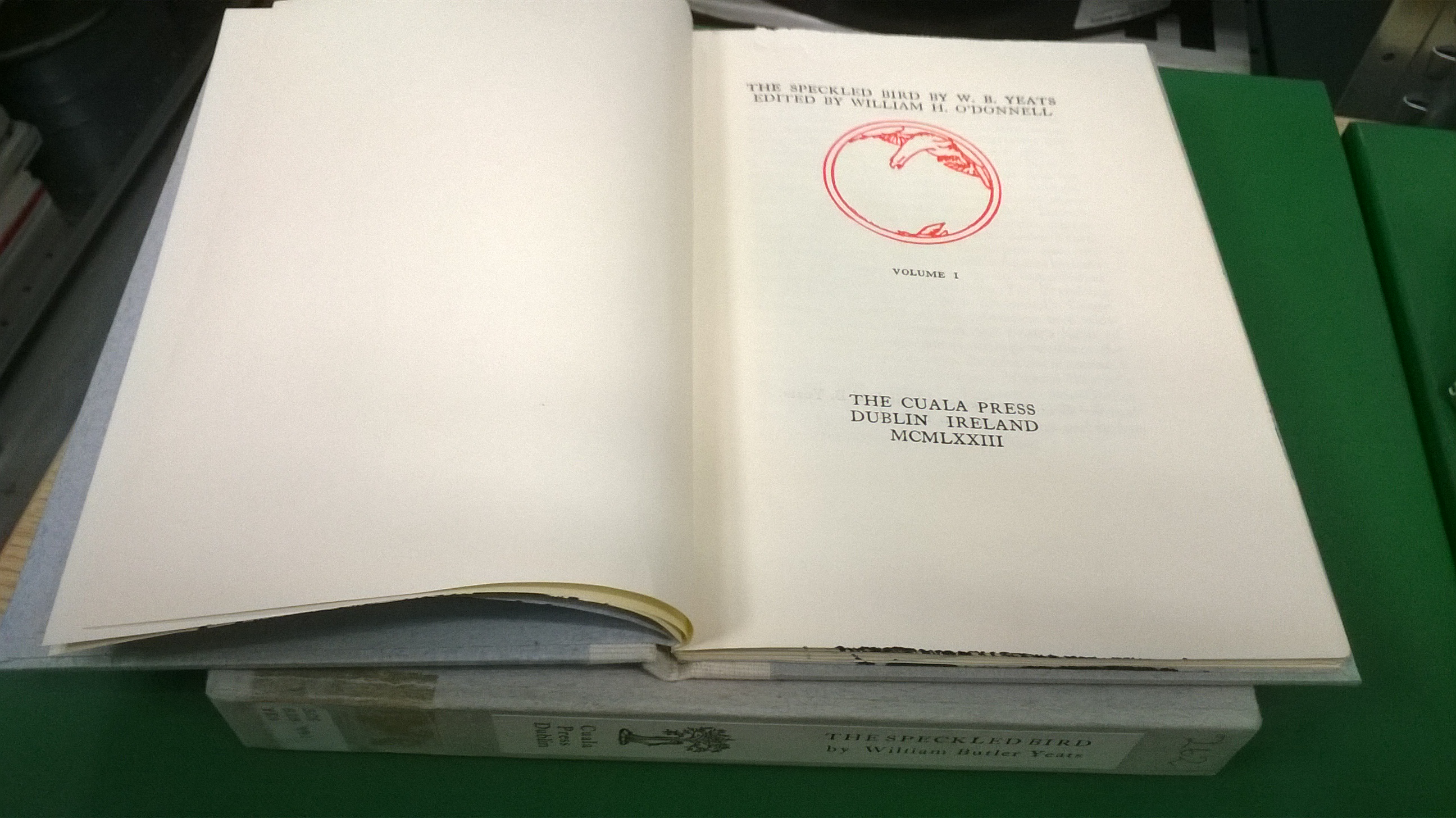
An entirely new display of Cuala Press books, all first editions, from W.B. Yeats, Lady Gregory, and Frank O’Connor, with illustrations by Elizabeth Rivers.

WP_20150908_15_47_09_Pro

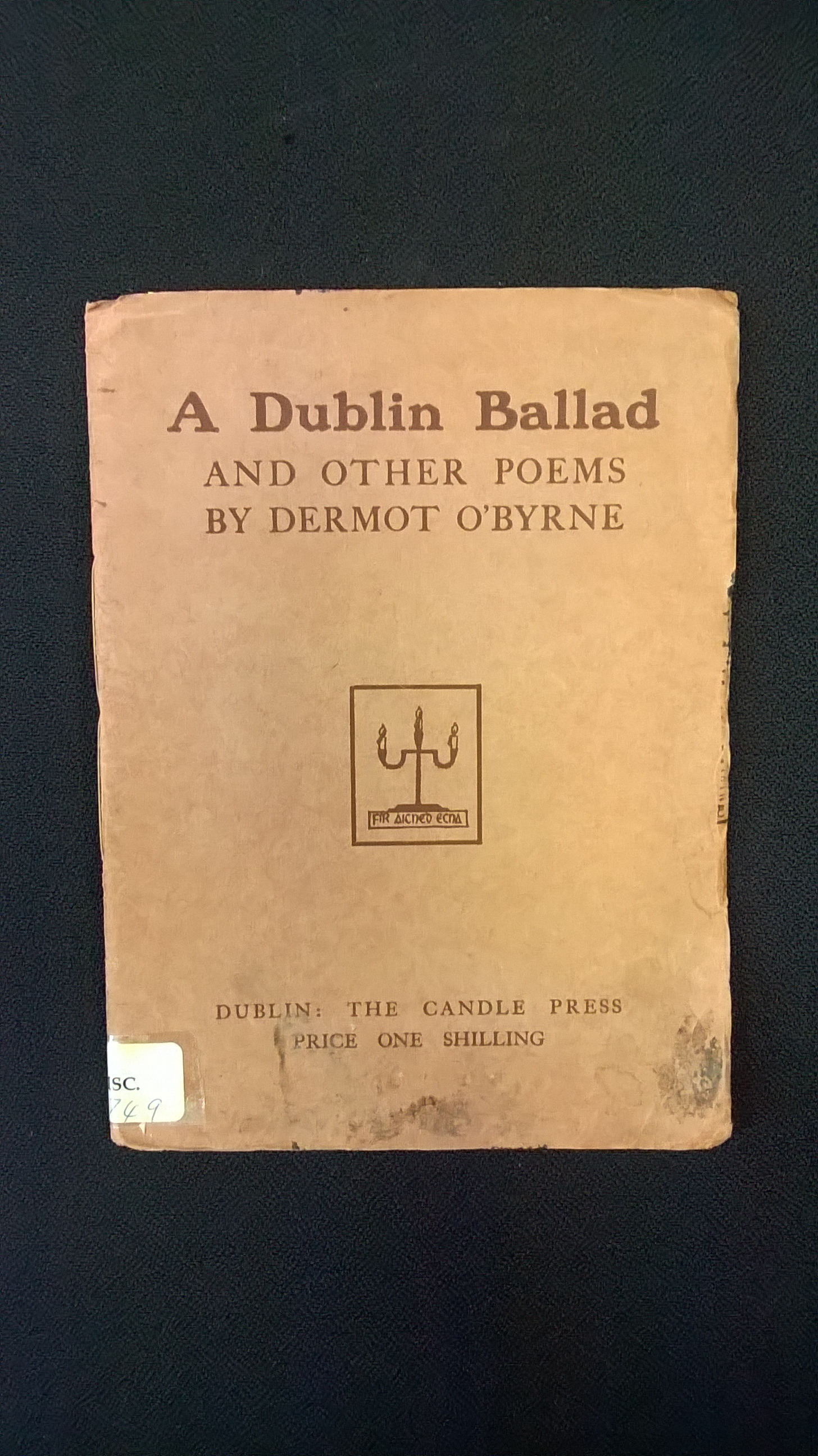
Poems about the Easter Rising by Dermot O’Byrne – actually the pseudonym of English composer Arnold Bax, whose tone poems based on Yeats’s poetry can be heard in the audio-visual part of the exhibition.

WP_20150910_025

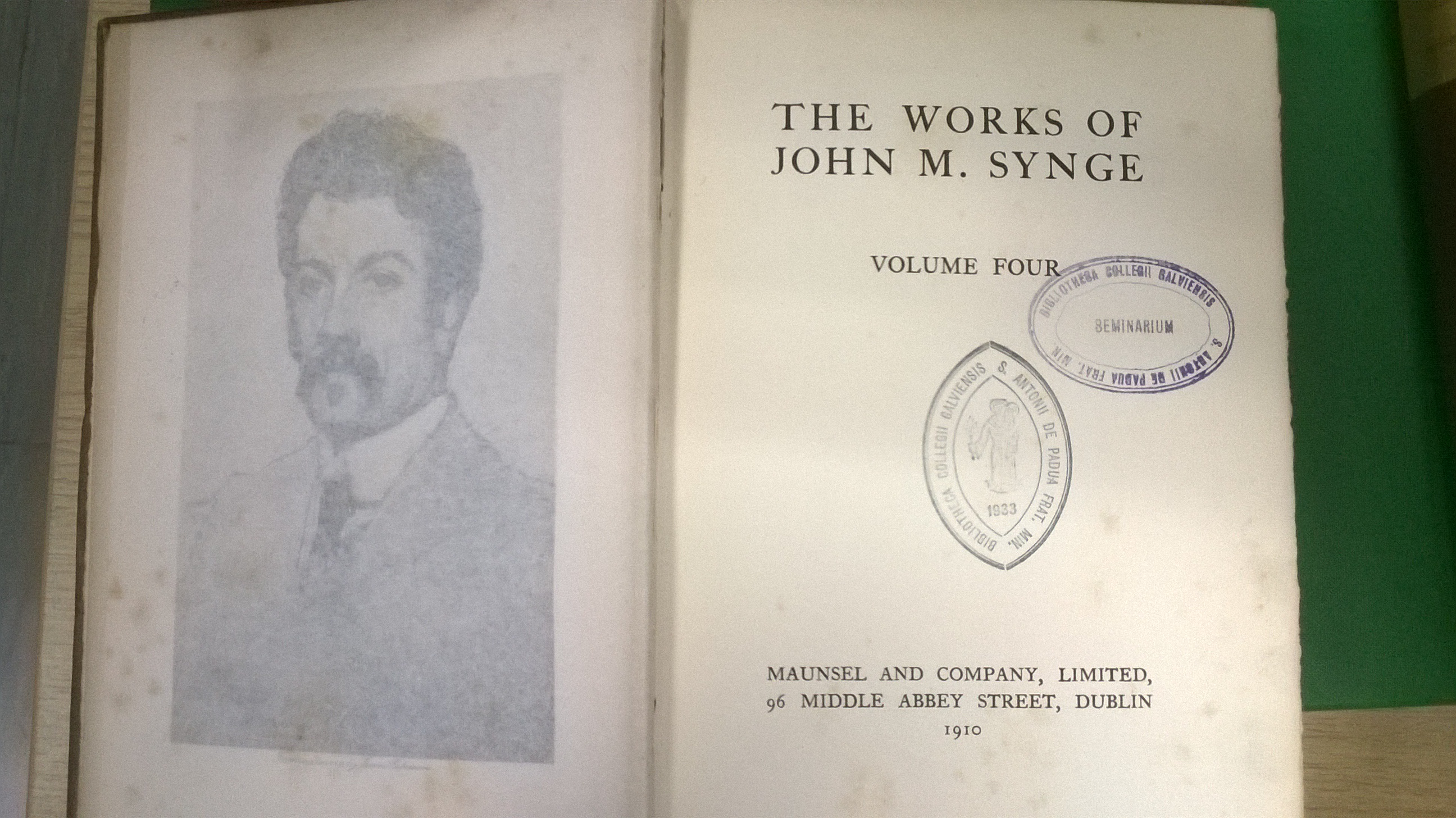
Collected Works of J.M. Synge edited by W.B. Yeats, and a deluxe edition of The Playboy of the Western World with colour illustrations by Sean Keating.

WP_20150910_12_19_41_Pro

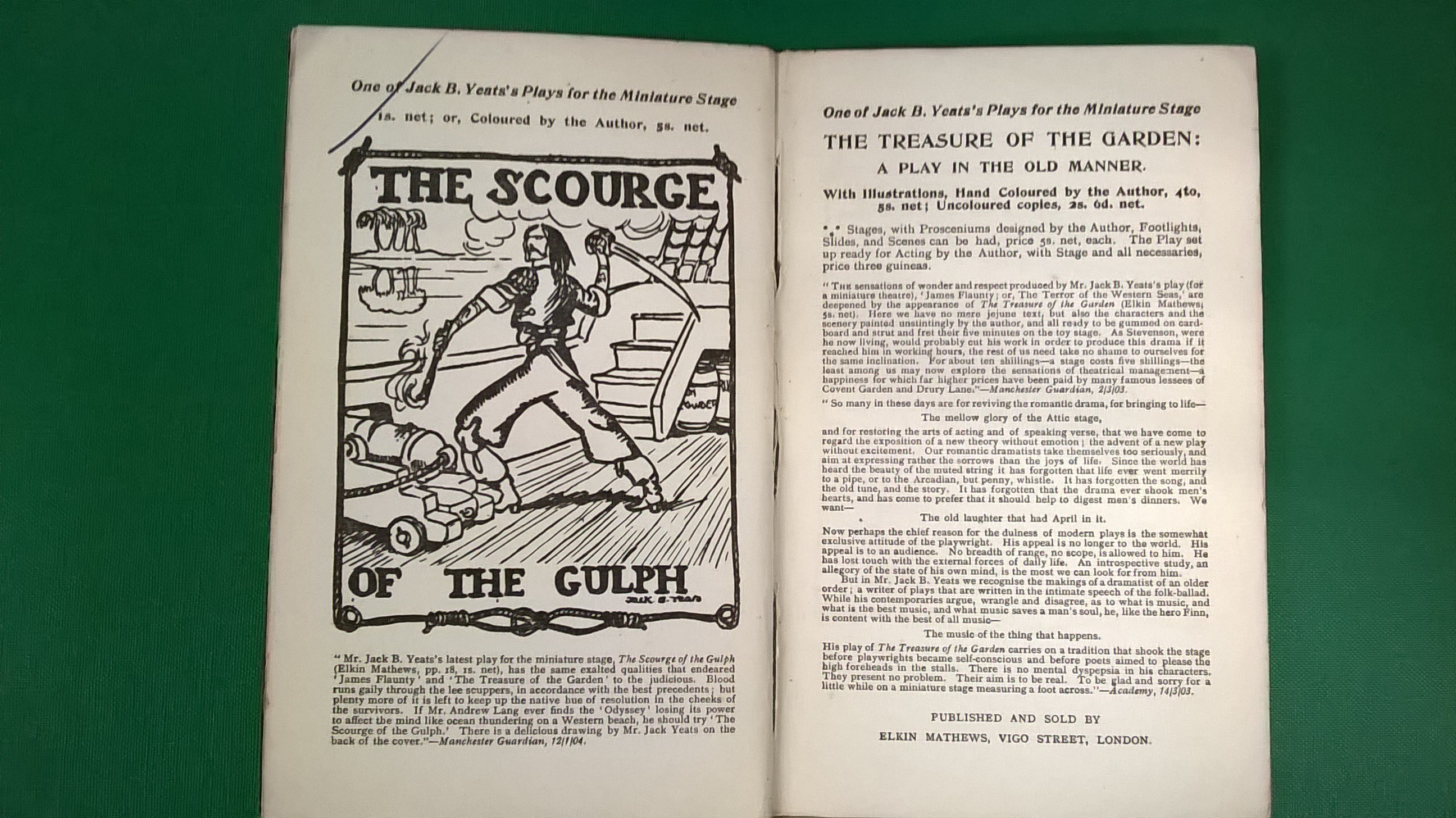
A new selection of exquisitely handcoloured Broadsides by Jack B. Yeats, Seamus O’Sullivan, and others, and a early book of Jack B. Yeats containing his early children’s theatre designs and even a pirate treasure map!

WP_20150908_16_57_35_Pro (2)

Also featuring as ever original artwork by Jack B. Yeats, Gerard Dillon, Fergus Bourke and Nicholas Feve. Manuscripts, rare books, music, video, and exclusive archival material from Belfast’s Lyric Theatre, the Abbey Theatre, and even the American west.

Y West Reading Room (2)

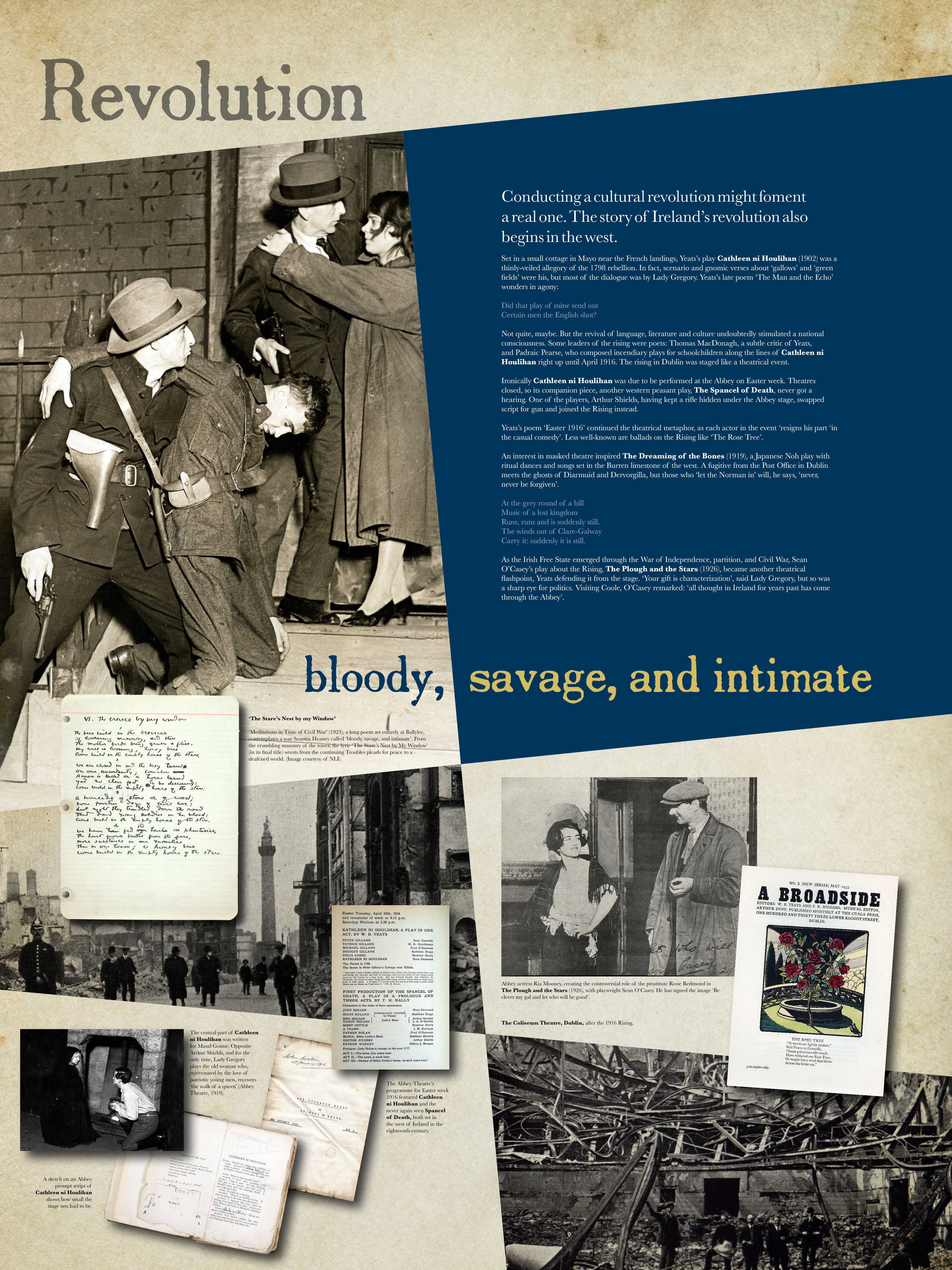
In this decade of commemorations come and find out more about the man who shaped and commented on the whole revolutionary decade. Discover the collaborations and collisions that formed modern Ireland, and deepened our culture.

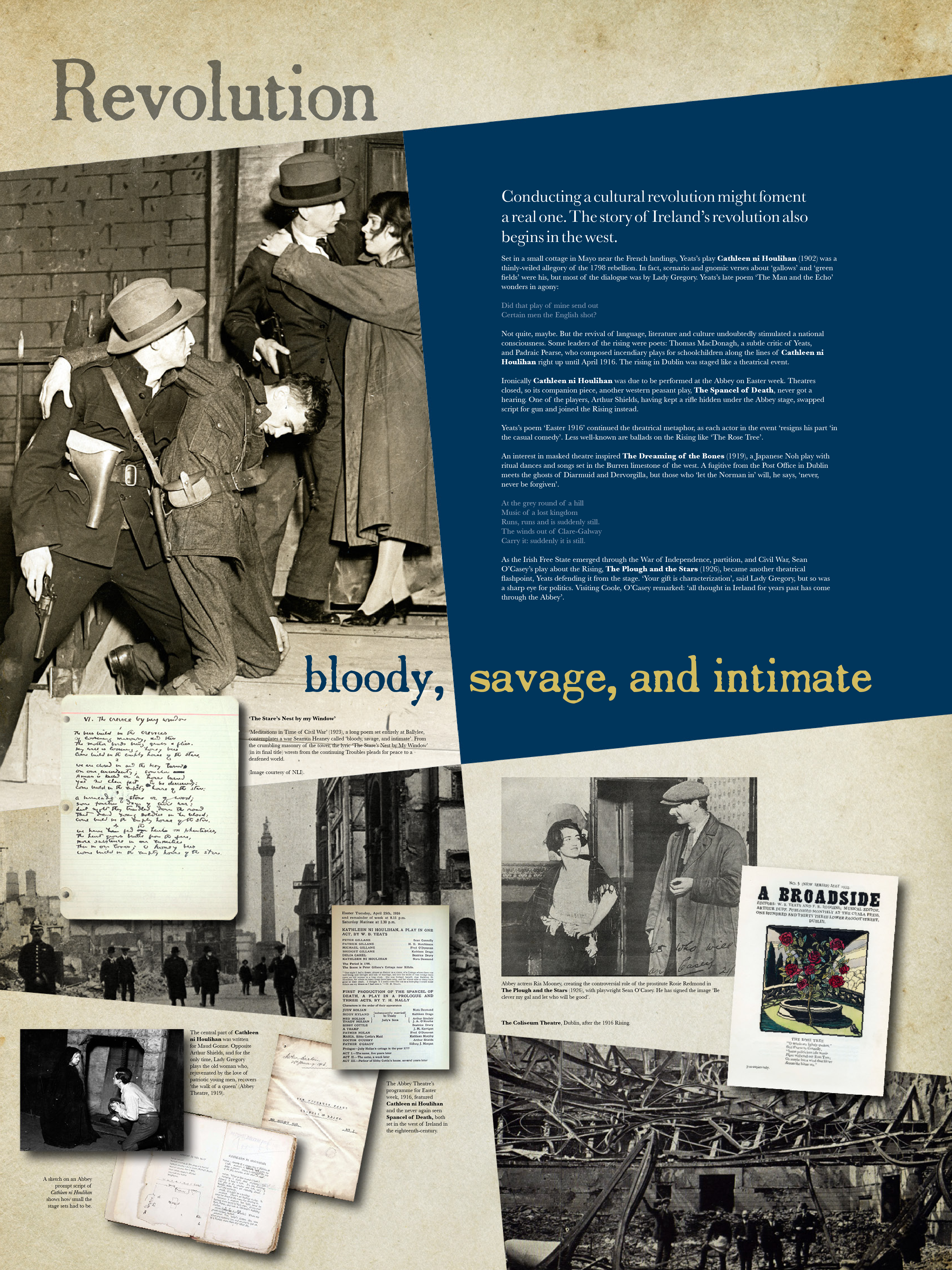
Panel 9

All this at Yeats & the West. The exhibition runs until December.


WP_20150908_15_24_44_Pro

At Galway Races

You might not have betted that an exhibition about Yeats & the West (on until December at the Hardiman Research Building, NUI Galway) had quite so much to do with horses. But the connections the exhibition illuminates between the Yeats brothers and horses, horseracing, and jockeys, are manifold. In honour of Galway race week we thought we’d look at some of the most interesting.

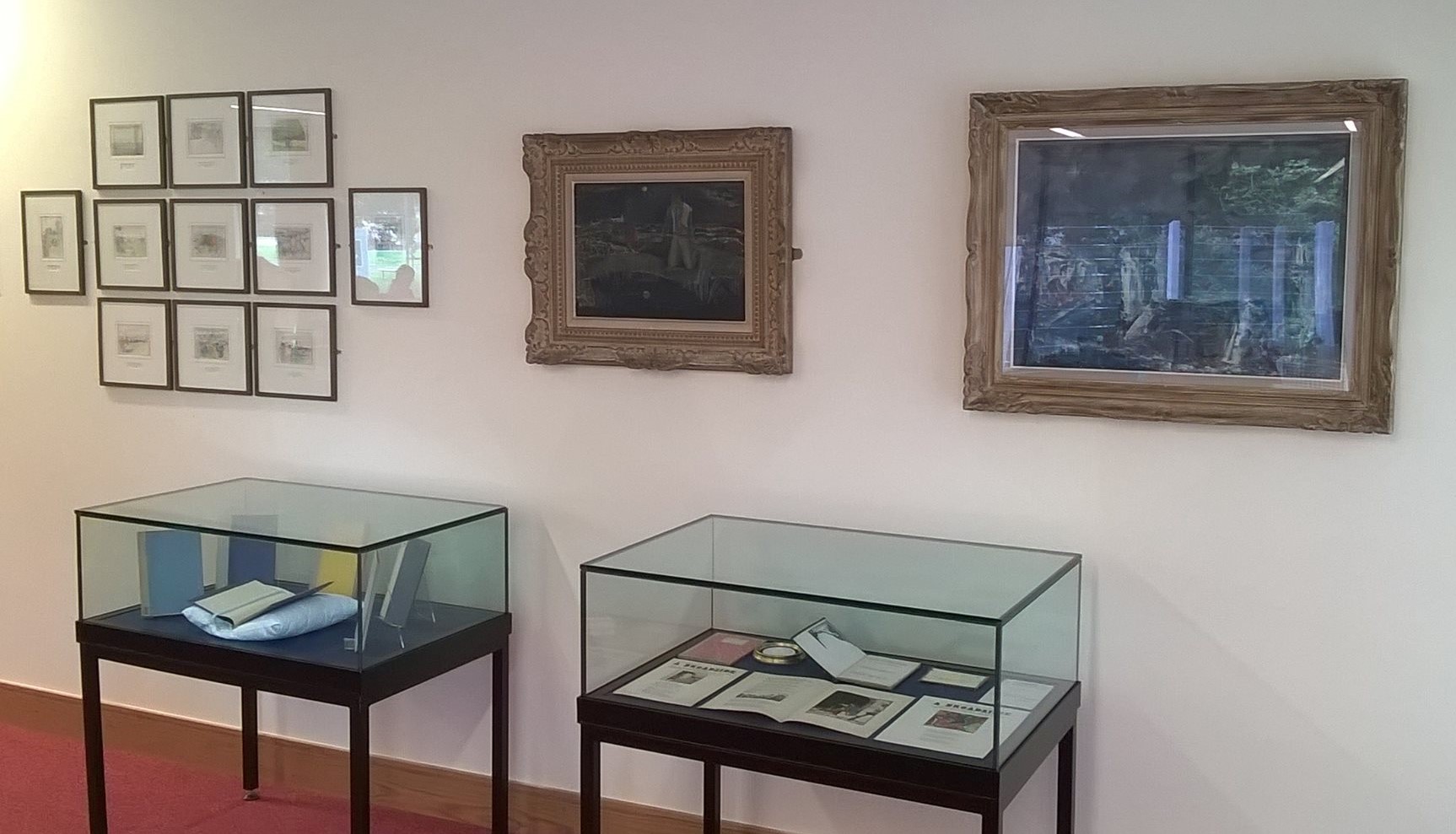
Both Yeats brothers attended Galway Races at important moments and found much to spur them. Amongst striking watercolour images of western scenes, Jack B. Yeats’s 1900 Galway sketchbook, each page individually framed and displayed in the special collections section of the exhibition, has a number of pictures devoted to Galway Races. One of the most intriguing includes alongside its solid brown horse and flimsier tents and flags, the crowd, grey and depersonalized, but still somehow very present and animated.

Jack’s brother W.B. Yeats also found the intensity of the crowd to be of great moment. His poem ‘At Galway Races’ contrasts the excitement and frisson of western horseracing crowds with the timid urban conservatism of theatre audiences:

At Galway Races

There where the course is,

Delight makes all of the one mind,

The riders upon the galloping horses,

The crowd that closes in behind:

We, too, had good attendance once,

Hearers and hearteners of the work;

Aye, horsemen for companions,

Before the merchant and the clerk

Breathed on the world with timid breath.

Sing on: somewhere at some new moon,

We’ll learn that sleeping is not death,

Hearing the whole earth change its tune,

Its flesh being wild, and it again

Crying aloud as the racecourse is,

And we find hearteners among men

That ride upon horses.

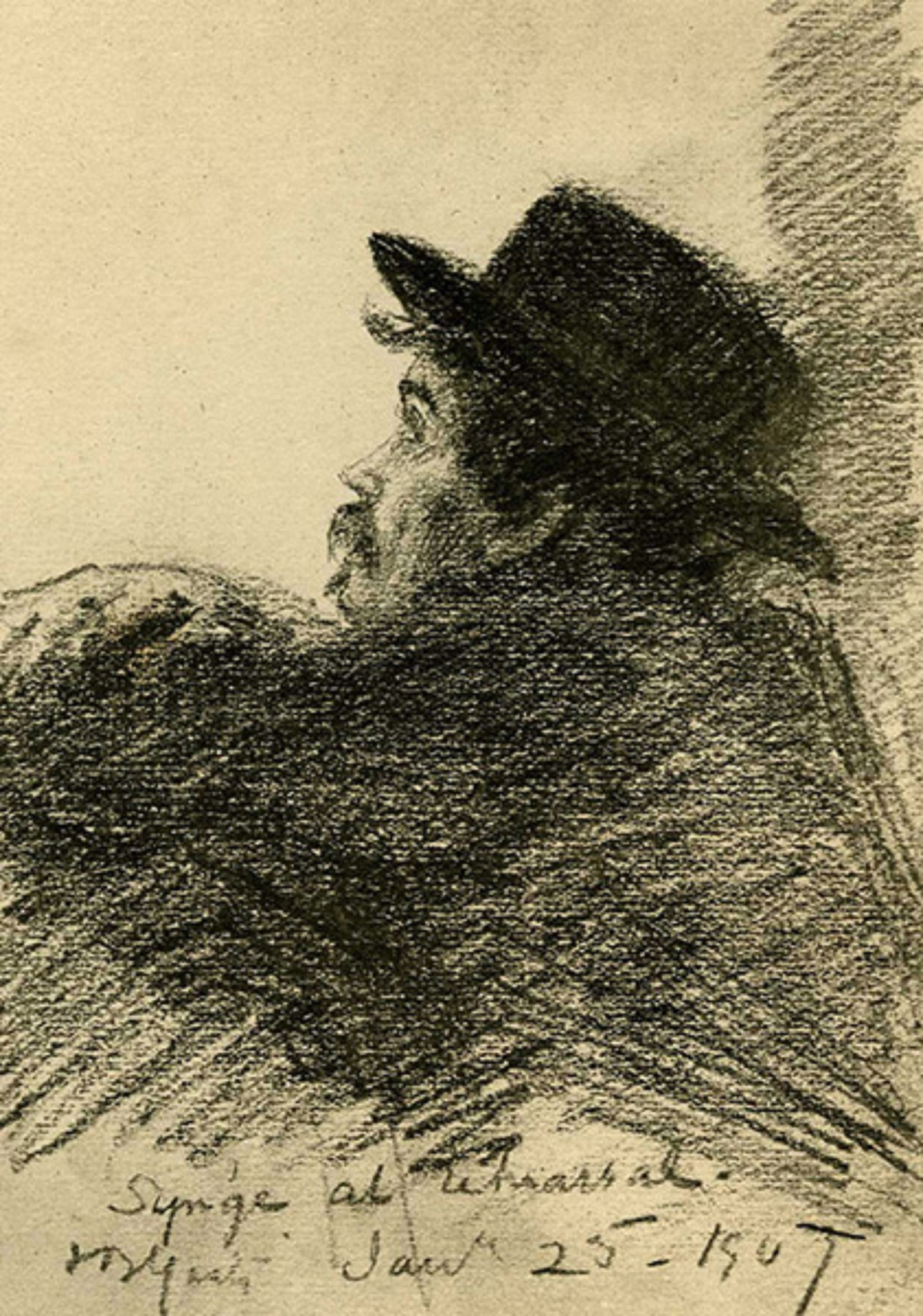
The whole world is caused to change its tune by horseracing’s cries and wild flesh: harnessing such Dionysian feeling, the excitement of an audience, of a crowd, is thus potentially revolutionary. The poem, published in The Green Helmet and Other Poems (1910) is written partly in honour of J.M. Synge and his revolutionary plays, set in the west. Synge had died in March 1909 around the time of the poem’s composition: Yeats was remembering and him the reception of his play The Playboy of the Western World, which itself includes on stage a group observing and excitedly commenting on a horse race.
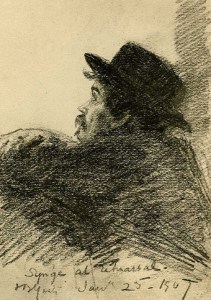
J.M.Synge at The Playboy of the Western World dress rehearsal, by John Butler Yeats

J.M.Synge at The Playboy of the Western World dress rehearsal, by John Butler Yeats

Jack B. Yeats made his own tribute to Synge and his stubborn revolutionary spirit. His Broadsides are a real feature of the exhibition, and are full of rebels, whether pirates or tinkers or circus performers or ballad singers singing salty songs. Produced just a few months after Synge’s death, a September 1909 Broadside had on its final page a defiant jockey figure, evidently named in honour of his good friend Synge, with whom he’d toured the west making illustrations for the Manchester Guardian.

Jack Yeats’s obsession with westerns and the rebel cowboys of novels, cartoons, theatrical productions and then movies, strikes another note that sounds throughout the exhibition: America. Another of his Galway sketchbook shows the presence of American flags at the Galway Races, suggesting he was not alone. Indeed, an engagment with the American west led the Abbey Theatre on tours as far west as Arizona and California, and the Abbey actors to Hollywood, where some fell under the spell of the great Irish-American western director John Ford. This map of the 1933 tour suggests how far west they got; Ford, with his 1952 film The Quiet Man, took them (and some horses) back home to Galway.
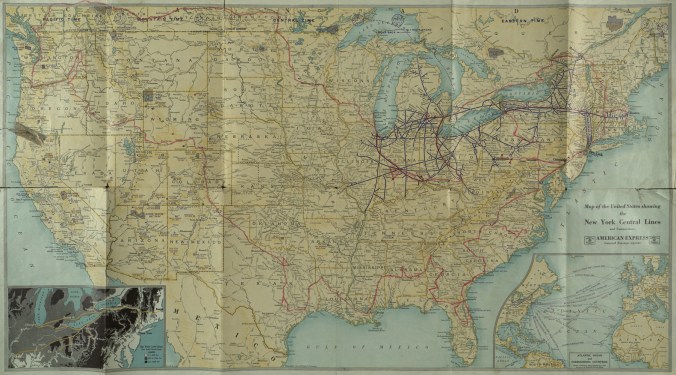
Map America

So, there are many horses hooves galloping their way through Yeats & the West: original images and energetic prints from the hand of Jack B. Yeats; from Yeats’s edition of Spenser, illustrations in a Beardsley-like style with sallow knights and slender horses by Jessie M. King; and Yeats’s own horsey epitaph, the manuscript of which (borrowed from the National Library of Ireland) shows that it originally read:

Draw rein, draw breath.

Cast a cold eye

On life, on death;

Horseman, pass by.

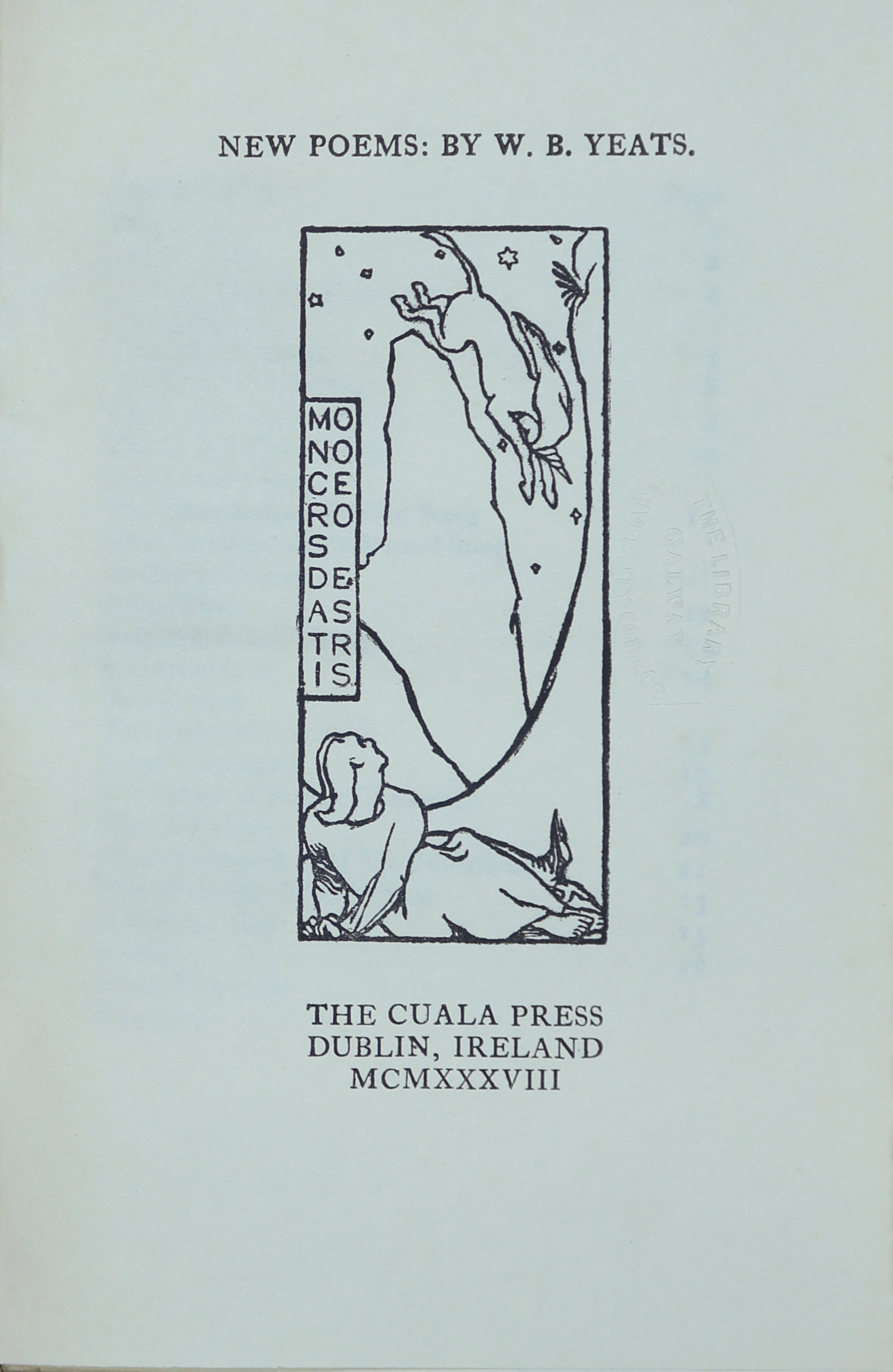
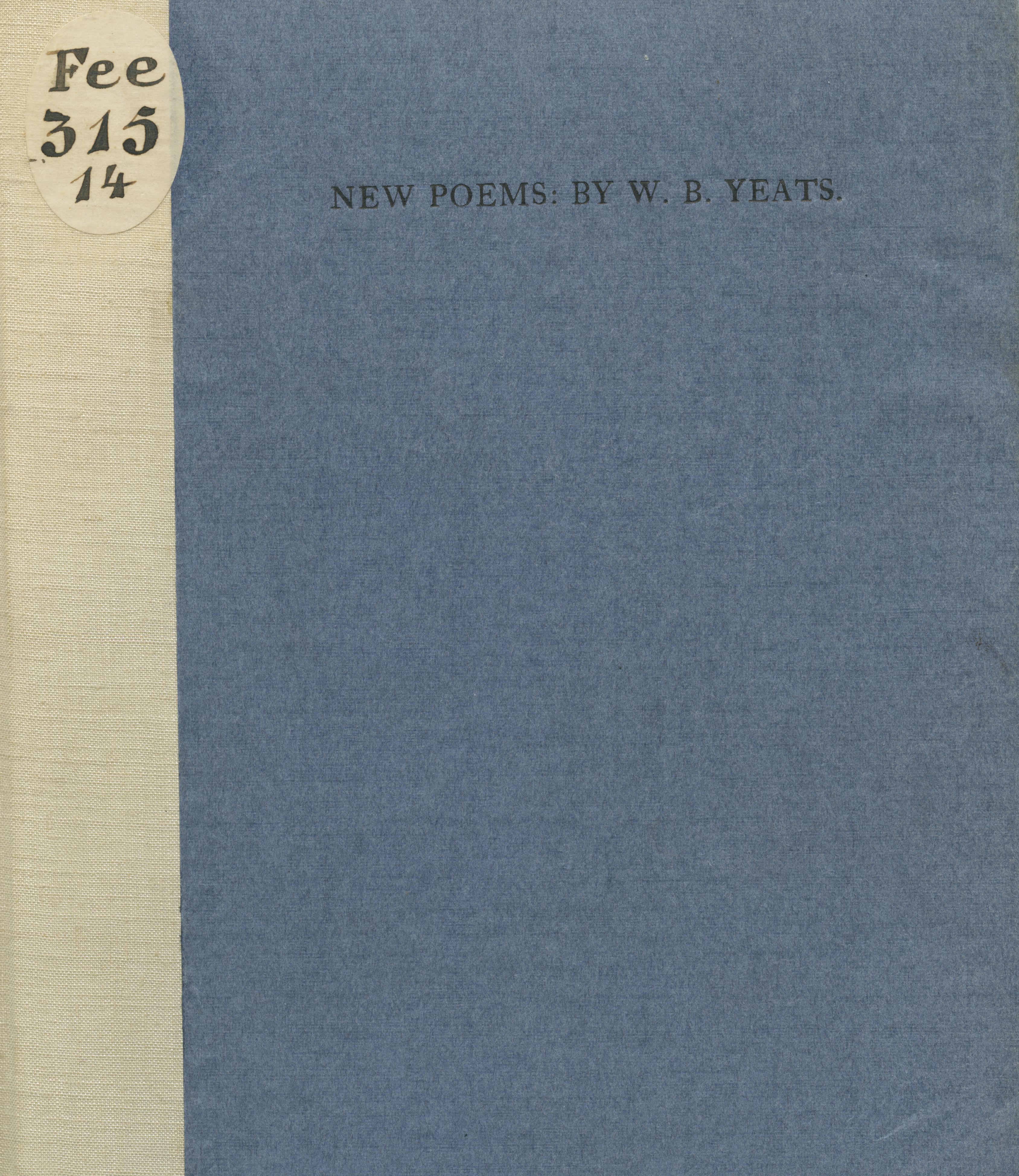
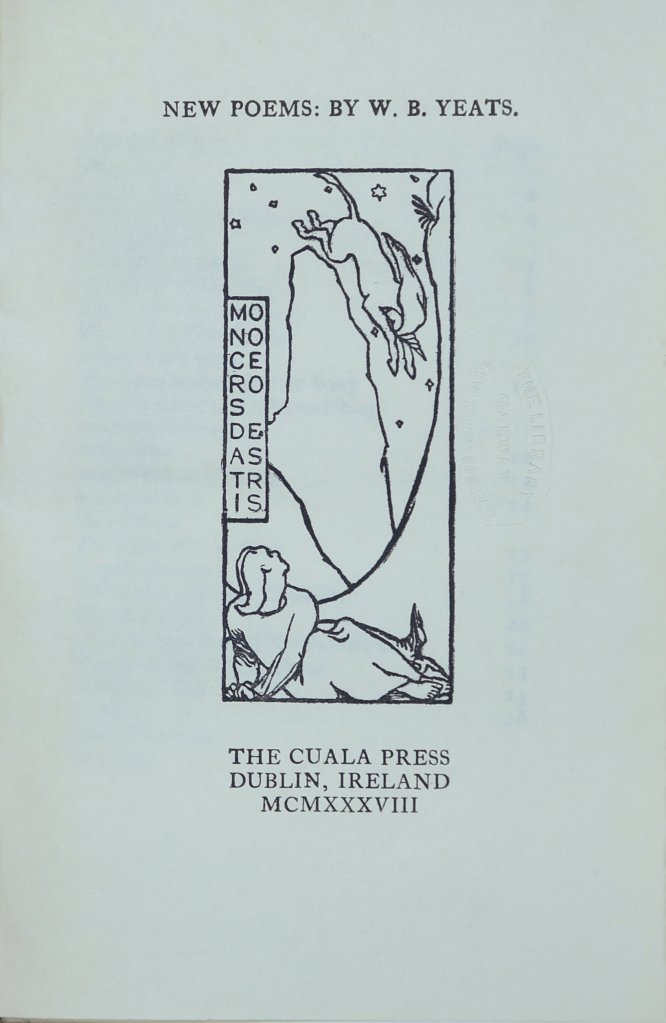
But rather than finish on such an ending, we finish this trot around the equestrian highlights of the exhibition somewhere altogether stranger. A new beginning is suggested by a more mystical image from Thomas Sturge Moore, which appeared at on the title page of the Yeats family’s Cuala Press books for years. This is from the Cuala Press edition of W.B. Yeats’s New Poems (1938), full of ballads and the strange Dionysian energy of Yeats’s late style. The illustration was originally conceived for Yeats and Augusta Gregory’s play The Unicorn from the Stars (1908), which through a character rejecting material existence itself reworks Yeats’s play Where There is Nothing (1902) (‘where there is nothing, there is God’).
New Poems (16)

Monoceros de Astris (Unicorn from the Stars) reads the Latin inscription. And Monoceros is indeed a faint constellation on the celestial equator. It was named by the Flemish astronomer and cartographer Pieter Platovoet, or Petrus Plancius, on a celestial globe of 1612. On the same globe, from which the International Astronomical Union still derives the names for these star patterns, the astronomer also named the constellation Camelopardalis, after the wonderful Greek word for giraffe. Our canter around the exhibitions hooved mammals would not be complete without mentioning Jack B.Yeats illustration from another 1909 Broadside, of a sailor triumphantly bringing home such a beast. In this image home is Ireland’s west, if the thatch and harp and shamrock in the window are to be believed. Truly there are more and stranger things in Yeats & the West than are dreamt of in our philosophy. The exhibition is open Monday to Saturday until the end of December.

Yeats & the West opening

YEATSANDTHEWESTINVITATION1 copy

Monday 13th July 2015 at 4.30 pm

Come and join us for the launch of Yeats and the West!

Kick off the Galway Arts Festival in style with our official opening.

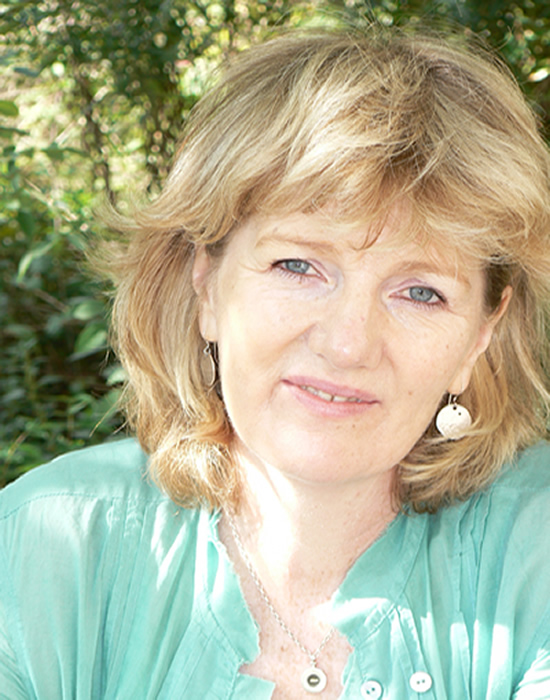
Take a tour of the exhibition with wine in hand. The opening features a reception with refreshments, introductory talks, and readings from our special guest Moya Cannon.

moya-cannon-Image

Through original artworks, rare books, music, drama, video, and a wealth of exclusive material from archives at NUI Galway and around the world, Yeats & the West explores the crafts, collaborations, and landscapes that revolutionized modern Ireland.

The exhibition features Jack B. Yeats, J.M Synge, Lady Gregory, Antoine Ó Rafteirí, Thoor Ballylee, Coole Park, and material from Loughrea Cathedral, the National Library of Ireland, the Abbey Theatre, the Lyric Theatre Belfast, and the American West.

Panel 9 C

Photo of tour participants

New Poems